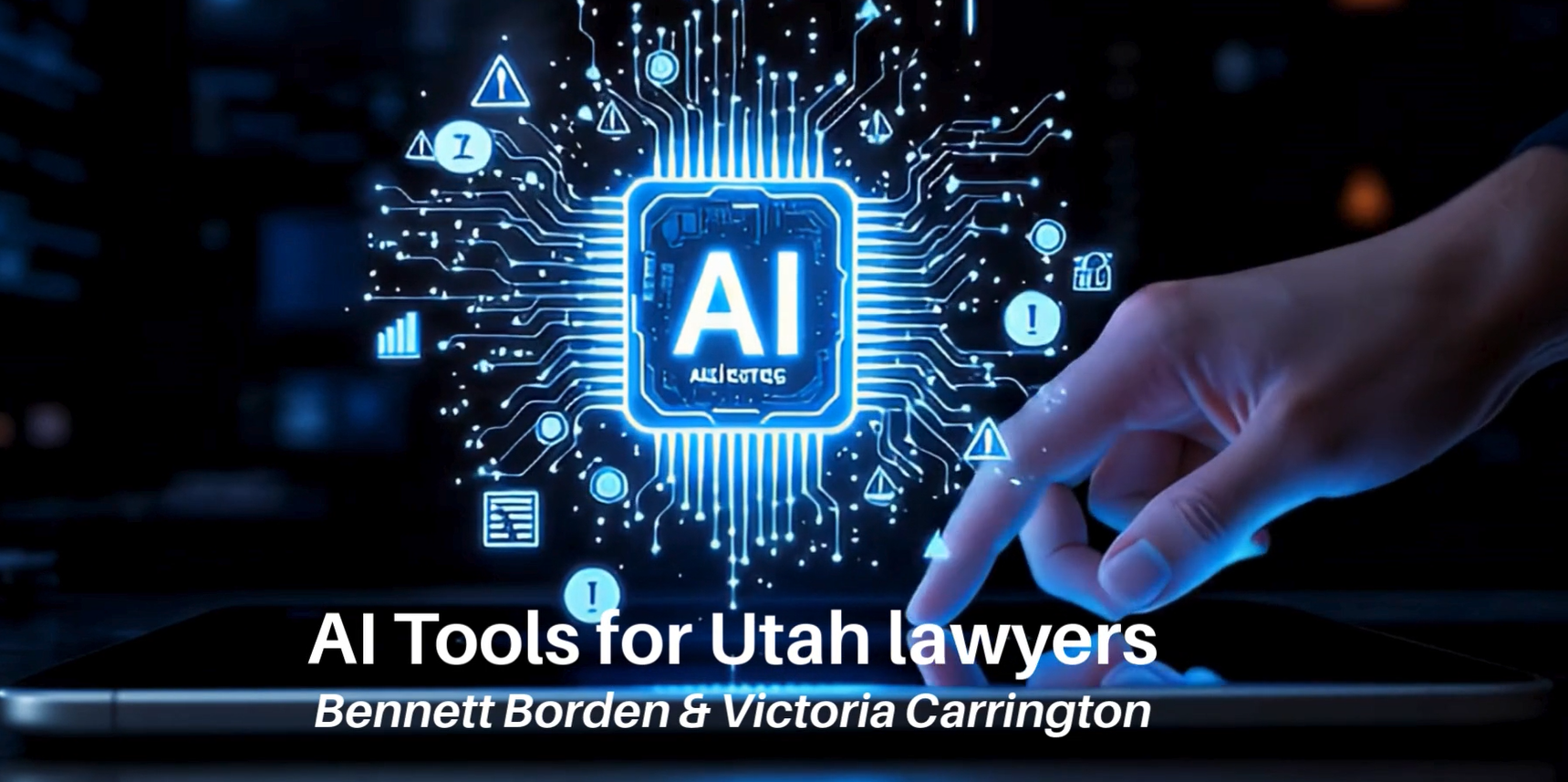
VIDEO: Exploring the GenAI Tools Transforming Legal Workflows

In a new 20-minute video, AI Committee Chair Bennett Borden and Innovation in Law Practice Committee Member Victoria Carrington provide a clear-eyed walkthrough of today’s most practical generative AI tools for legal professionals. Their discussion focuses not on hype, but on how these technologies can responsibly augment legal work while preserving the ethical rigor that defines the profession.

Bennett BordenBorden and Carrington spotlight several widely used platforms, such as ChatGPT, Microsoft Copilot, Zoom AI Companion, Notebook LM, Notion AI, and others. They talk about each platform offering targeted capabilities that can streamline research, expedite drafting, support matter organization, or clarify complex concepts for clients and colleagues. Whether used to summarize lengthy documents, generate issue-spotting outlines, or organize case-related materials, these systems can help lawyers reclaim valuable time for higher-order analysis and client engagement.

Victoria Carrington

The presenters reiterate an essential principle throughout: no AI tool should ever replace legal judgment. Outputs must be reviewed, verified, and refined by a licensed professional. Copy-and-paste shortcuts, no matter how tempting, risk undermining accuracy, confidentiality, and professional responsibility. AI is an accelerant, not an autopilot.

RELATED: Navigating Generative AI in Law: Five Ethical Principles Every Lawyer Should Remember

For Bar licensees seeking to explore these tools in a structured and reliable way, the video also highlights the LexisAI resource page in the Practice Portal, available at no cost. This curated environment offers guided access to trusted research support, helping practitioners incorporate generative AI into their workflows without compromising quality or compliance. (As a Bar licensee, you also have the benefit of receiving a 15% discount when purchasing LexisAI.)

As Borden and Carrington emphasize, generative AI is not about changing what it means to practice law; it is about changing how legal work gets done. For seasoned attorneys, emerging practitioners, and even clients navigating their own documents, these tools can illuminate pathways through legal complexity — provided they are used thoughtfully, ethically, and always under the steady hand of human expertise.

*AI assisted with the writing of this blog.

Legislative–Judicial Tensions Addressed Head-On in Utah State Bar’s ‘Let’s Talk & Let’s Listen’ Forum

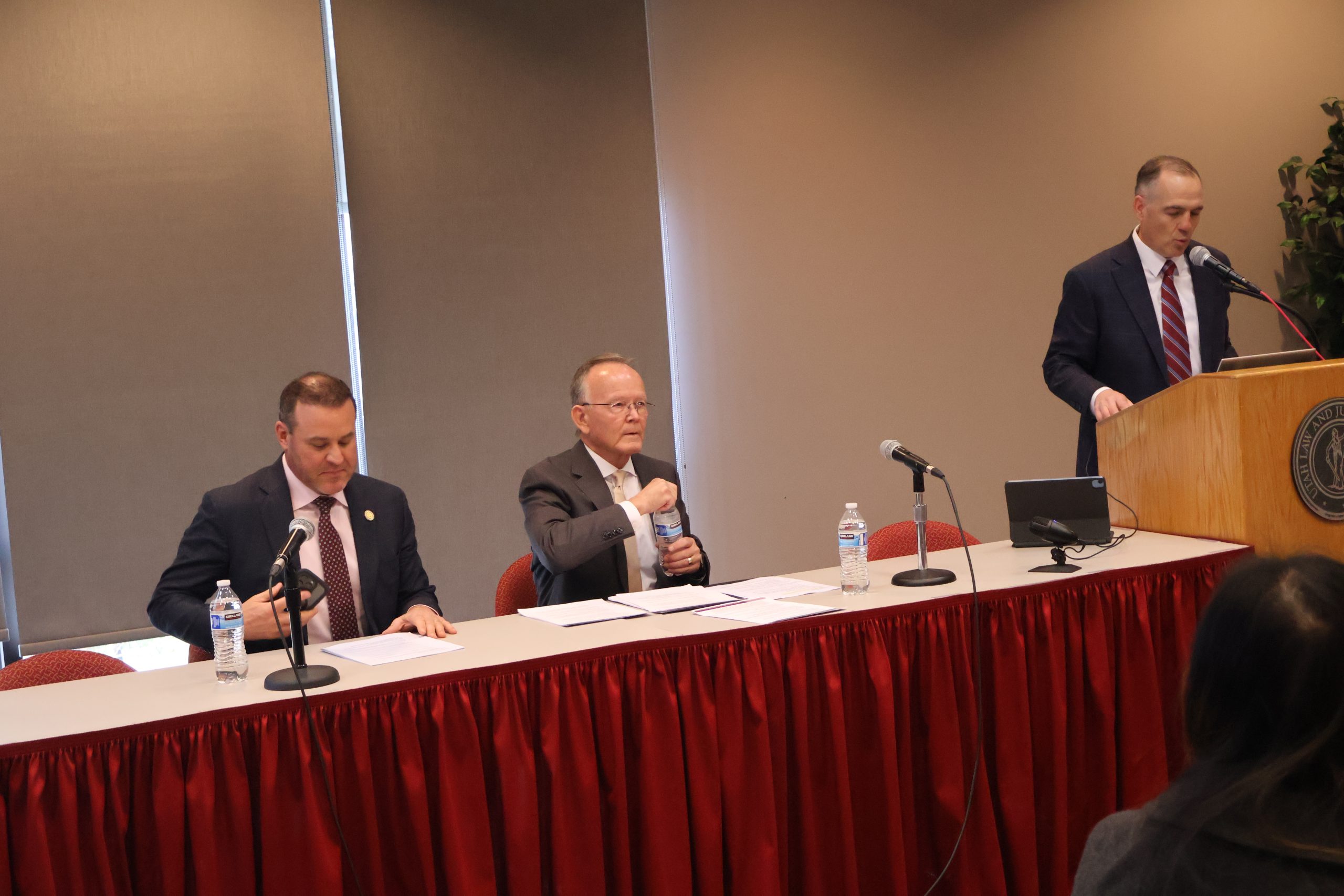
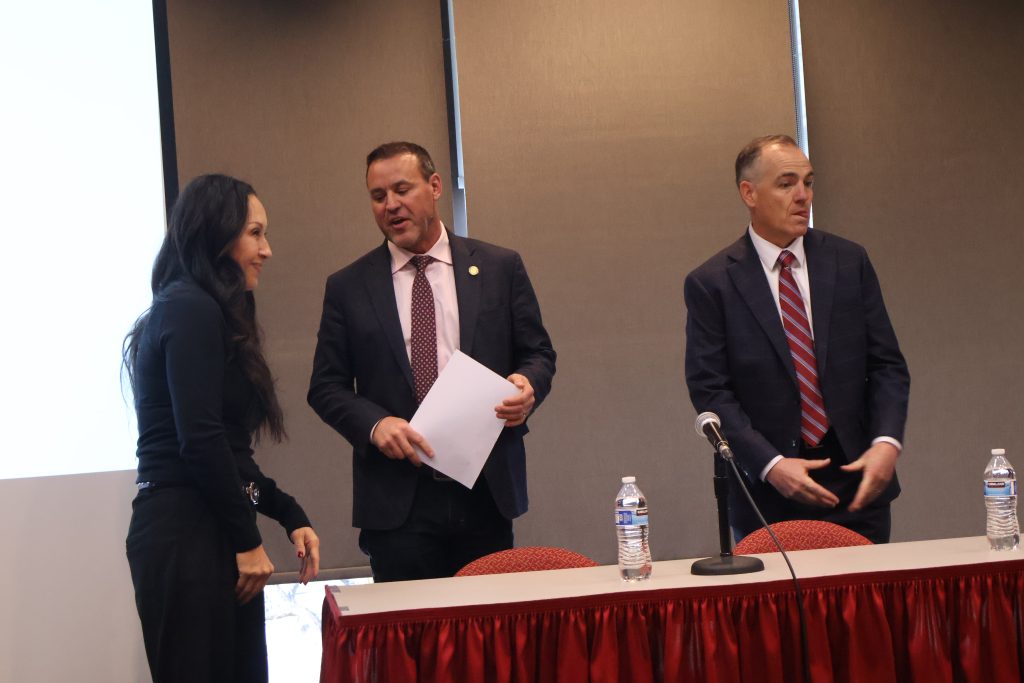
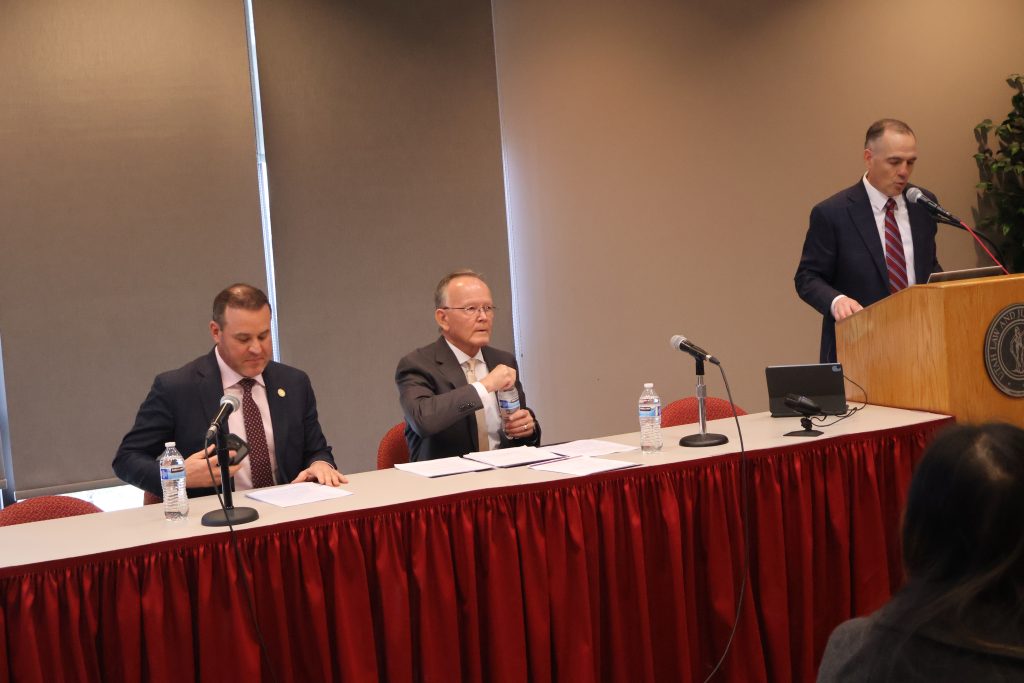
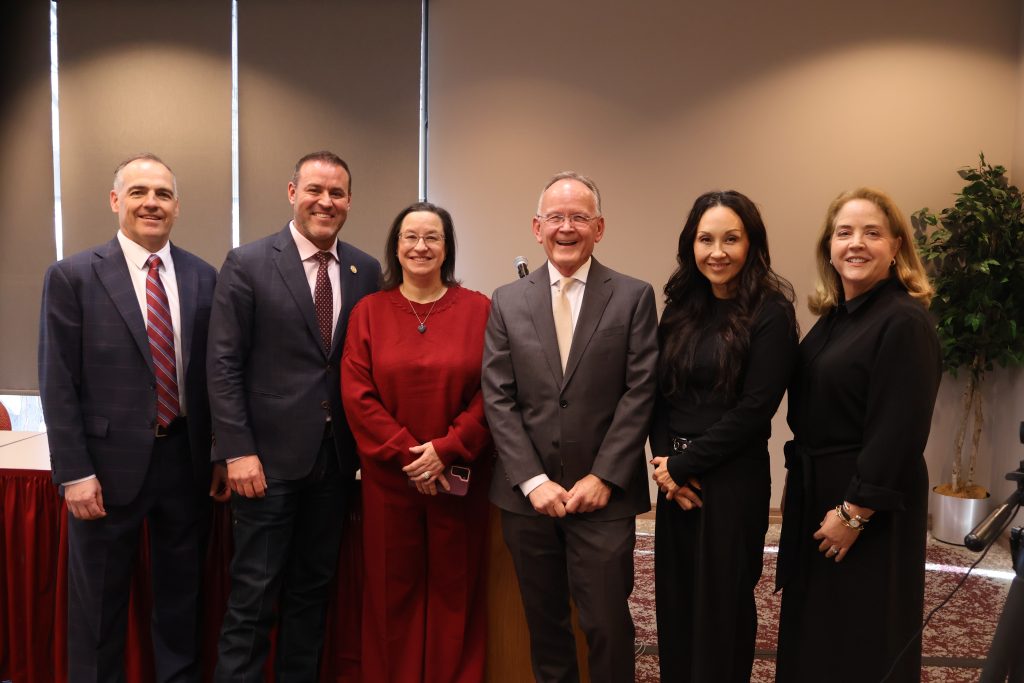
On Wednesday, the Utah State Bar was pleased to host Utah Senate President Stuart J. Adams and Utah House Speaker Mike Schultz in the first of its continuing legal education (CLE) dialogue series, Let’s Talk & Let’s Listen. The two-member panel was moderated by full-service litigator Keith A. Call. More than 700 legal professionals joined the session online, with another 60 individuals, including dignitaries, attending in person for the forum that examined the respective roles of Utah’s three branches of government.

“The timing of this event carried particular significance, considering recent policy disagreements and procedural rifts between the legislature and the judiciary, which have underscored the need for renewed engagement across branches of government,” said Utah State Bar President Kim Cordova. “This CLE was intentionally positioned as an opportunity to model constructive discourse marked by civility, respect, and adherence to the standards of professionalism. By convening legislative leaders and the legal community, the Bar sought to reinforce the shared commitment to safeguarding the constitutional framework and improving interbranch understanding.”

The main discussion began with the moderator highlighting the increasing tension between the legislature and the judiciary. Adams and Schultz both agreed that emotions have reached a “fever pitch” with recent court rulings about abortion, voting, redistricting, and other matters. The legislative leaders were candid about their viewpoints on the balance of power between the branches of government and the responsibilities borne by the courts and attorneys licensed by the Bar in supporting constitutional governance.

The Bar offered one hour of pending e-verified live mandatory CLE credit for its licensees who registered in advance and submitted questions for Adams and Schultz to answer. Those questions and proposed topics, which were synthesized and presented by the moderator, included:

  • What would you like the Utah judiciary to understand about your recent concerns regarding court rulings?
  • What has the Supreme Court and District Court got wrong? 
  • Are threats of violence against judges, legislators, or any public servants appropriate?

Adams and Schultz expressed their passion for their roles as elected officials of their constituents, to act in their best interests and fulfill their constitutional obligations as the “voice of the people” in setting policy. Both men said they take their responsibilities seriously, with Adams emphasizing that he’d do everything within his power to protect our democratic republican form of government. He added that the current divisive issues are not partisan, but Constitutional in regard to checks and balances of the state’s government system.

“Even as today’s discussion highlighted the very real and consequential disagreements between the legislature and the judiciary, I appreciate the willingness of President Adams and Speaker Schultz to engage with Utah lawyers on matters that are both sensitive and currently before the courts,” said moderator Call. “Bringing these conversations into a structured, professional forum reinforces the value of open dialogue and the shared duty to uphold the rule of law.”

Part One of the series concluded with a reaffirmation of the importance of open dialogue among civic institutions and the role of attorneys in fostering informed, principled, and respectful engagement. Participation was made available at no cost through the support of sponsoring law firms Snell & Wilmer and Spencer Fane. Part Two of the CLE series will feature Chief Justice Matthew B. Durrant on March 17th in commemoration of the Bar’s 95th Anniversary.

Disclaimer: CLE credit was only available to registrants who attended the hybrid event on Wednesday, December 10, 2025. It is no longer available.

Join us in engaging with Utah’s lawmakers. They do want to hear from you.

  • Go to the Utah Legislature website (https://le.utah.gov/) and select “Legislators.”
  • Then click on “FindbyAddress/Map” and enter your address to see your Senator and Representative.

Contact Them

  • Each legislator’s page lists their email and phone number.

Additional Contacts

  • Utah Senate: 801-538-1035 | Senate Roster
  • Utah House: 801-538-1029 | House Roster

Utah State Bar Warns Licensees About Phishing Scam Impersonating Its Executive Director

The Utah State Bar is aware of a fraudulent email currently circulating that impersonates our Executive Director, Elizabeth Wright. It uses a deceptive email address — elizabeth.wright@ utahbar.org.sendcrp.com — that is not affiliated with the Bar.

The phishing email:

  • Addresses recipients by name (e.g., “Dear [First Name] [Last Name]”)
  • References “a matter that surfaced earlier this week involving a small number of firms including your firm [Firm Name]”
  • Requests that you reply with your phone number so the sender can “reach you directly”

This message did not come from the Utah State Bar and should be treated as a phishing attempt.

What You Should Do

Please do not reply to the email, and do not provide your phone number or any other personal or firm information. Simply delete the message from your inbox or report it as phishing to your email provider.

For more information about cyberattacks, read the blog from the Bar’s IT Director, Avoid Cyberattacks Over the Holidays in Your Law Practice – Utah State Bar

Avoid Cyberattacks Over the Holidays in Your Law Practice

By Spencer Twede
Utah State Bar IT Director

Spencer Twede

Holiday celebrations with family, friends, and colleagues are upon us, and we’re all thinking about a lot right now. Who can pick me up from the airport? Did I send that donation, or is the envelope still on my desk? What am I going to gift to the neighbors? Will those holiday cards arrive on time if I mail them today?

We’re juggling so much that we can’t possibly pay attention to everything at once. And somehow, in the chaos, we’ve forgotten to order catering for the office party.

Cybercriminals know this all too well. They know we’re distracted, stretched thin, and operating with limited mental bandwidth.

One leading security firm reports a 30% increase in cyberattacks during holiday periods and a 25% increase in phishing attempts year-over-year. The Cybersecurity and Infrastructure Security Agency (CISA) have also warned that ransomware attacks spike during holiday weekends, highlighting an 82% increase in ransomware-related losses across just two recent years.

This all sounds scary, but the good news is that a few simple habits can go a long way toward protecting you, your clients, and your firm. Here are seven easy tips to help you celebrate with a bit more peace of mind:

  1. Power Off Your Computer While You’re Away: Fully shutting down your work computer helps prevent remote access attempts or unauthorized use. An offline system is much
    harder to compromise than one quietly connected to the internet.
  2. Beware of Urgent or Too-Good-To-Be-True Messages: Phishing attempts spike every holiday season. Scammers send fake tracking updates, “special holiday deals,” charity requests,
    or even urgent, spoofed client matters. Slow down before you click. Don’t let a moment of haste ruin your holiday.
  3. Avoid Overly Revealing Out-of-Office Replies: An out-of-office message that announces you’re out of the country or unavailable until a specific date can signal to attackers
    that your attention is elsewhere. Keep it polite, brief, and vague.
  4. Be Cautious on Public Wi-Fi: Travel often means connecting to airport, hotel, or café Wi-Fi. If you must use these networks, avoid accessing sensitive data
    without a VPN, and disable automatic Wi-Fi connections so you remain in full control.
  5. Verify Unusual Client or Coworker Requests: Impersonation is easy and common. Be wary of unusual wire transfers, document access requests, or anything asking for your login credentials. Always verify unexpected requests using a known, separate communication channel.
  6. Think Twice Before Posting Travel Photos: Sharing real-time vacation updates can create both digital and physical security risks. As you leave for the airport, you wouldn’t stop to put a sign in your yard saying you’re on the beach in Hawaii. Treat your social media the same way and save the posts
    for when you get back.
  7. Don’t Leave Work Devices in Your Car: Theft increases significantly during the holiday shopping season. A stolen device isn’t just an inconvenience; it can be a serious data breach. Always bring laptops and tablets inside, even during quick errands.

Nobody wants to return from holiday break to discover their email was phished; client data is being held for ransom, or that a “co-worker” they hurriedly sent a gift card to was actually a scammer overseas.

A little extra care now can save a lot of trouble later. When it comes to cybersecurity during the holidays, a few simple steps really do pay off.

Spencer Twede is the IT Director of the Utah State Bar with a background in psychology and Spanish from Weber State University
and a Master of Science in Information Technology Management from Western Governors University. He has worked in technology
across multiple sectors, including support services for Apple and K-12 public education.

Utah Judiciary Announces Change to Public Parking at the Matheson Courthouse

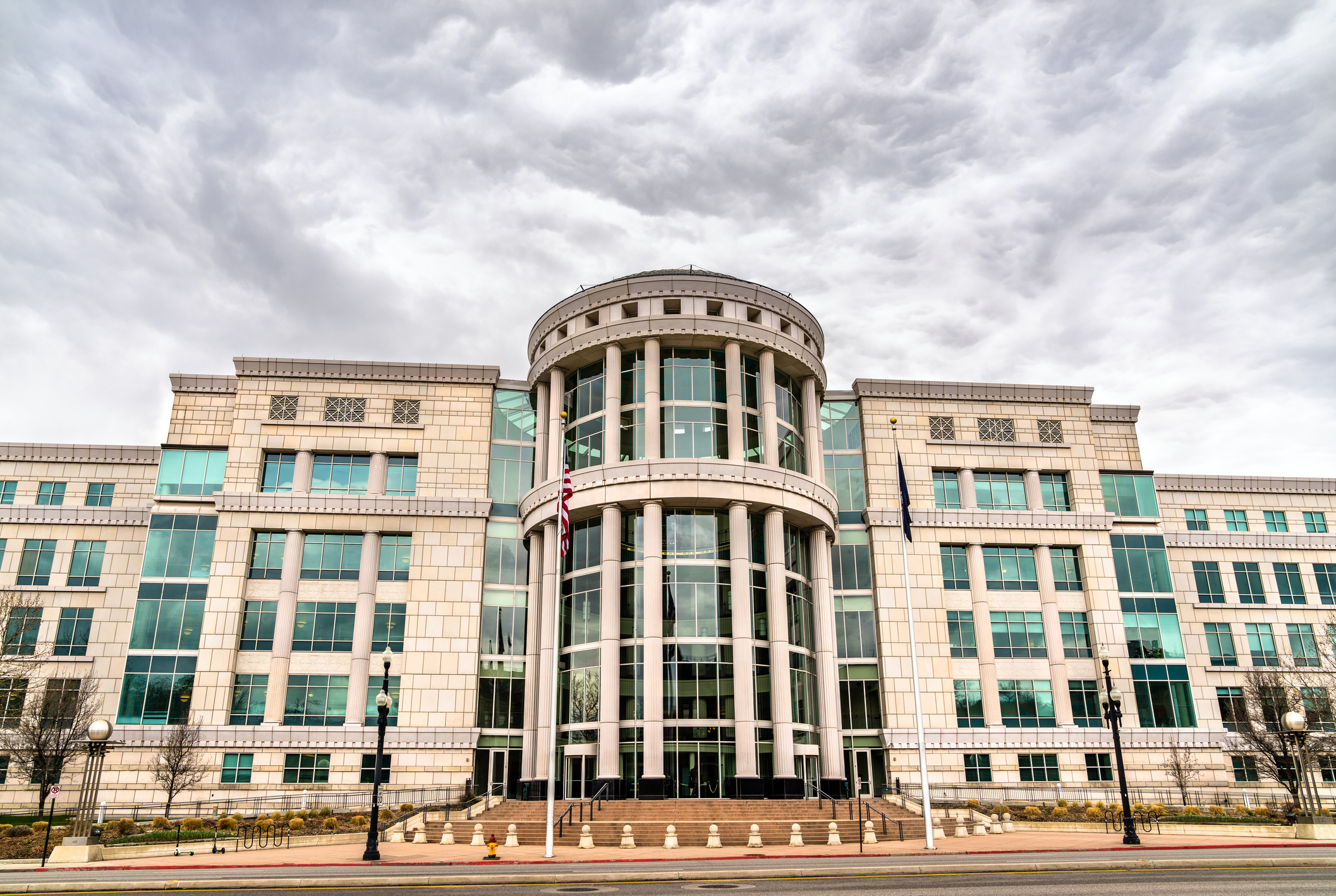
Salt Lake City, (Nov. 24, 2025) —The Utah State Courts today announced that public parking in the underground garage at the Scott M. Matheson Courthouse will be discontinued effective January 1st, 2026.

This change is part of an ongoing effort to enhance courthouse safety and security while maintaining convenient access for court users, jurors, attorneys, and the public.

“The Matheson Courthouse is one of the busiest judicial facilities in the state,” said Chris Palmer, Director of Security for the Utah State Courts. “This adjustment aligns with national security standards and is a proactive measure to better protect the public and court employees while ensuring continued access through nearby parking options.”

Members of the public visiting the courthouse are encouraged to use public transit, including the TRAX Courthouse Station, which is located directly adjacent to the courthouse, and multiple UTA bus routes that serve the surrounding area. Several public parking facilities within one block of the courthouse are also available, including:

  • 500 South Surface Lot
  • WaFed Building Garage (405 S. Main Street)
  • 175 East 400 South Lot
  • Salt Lake City metered street parking

This decision follows a multi-agency review involving the Salt Lake County Sheriff’s Office, Utah State Courts Security, and the Administrative Office of the Courts. The review considered operational efficiency, national security guidance, and the availability of alternative parking resources in downtown Salt Lake City.

Parking will continue to be available for jurors. Public communication materials, including signage and advance notifications, will be issued ahead of the transition.

“This is a careful, balanced decision,” Palmer added. “Public access remains a top priority. The goal is to ensure that access occurs in a way that maximizes safety for everyone in the courthouse”.

Updated maps, parking information, and answers to frequently asked questions will be posted at www.utcourts.gov and displayed on-site prior to the effective date.

# # #

VIDEO: Navigating Generative AI in Law: Five Ethical Principles Every Lawyer Should Remember

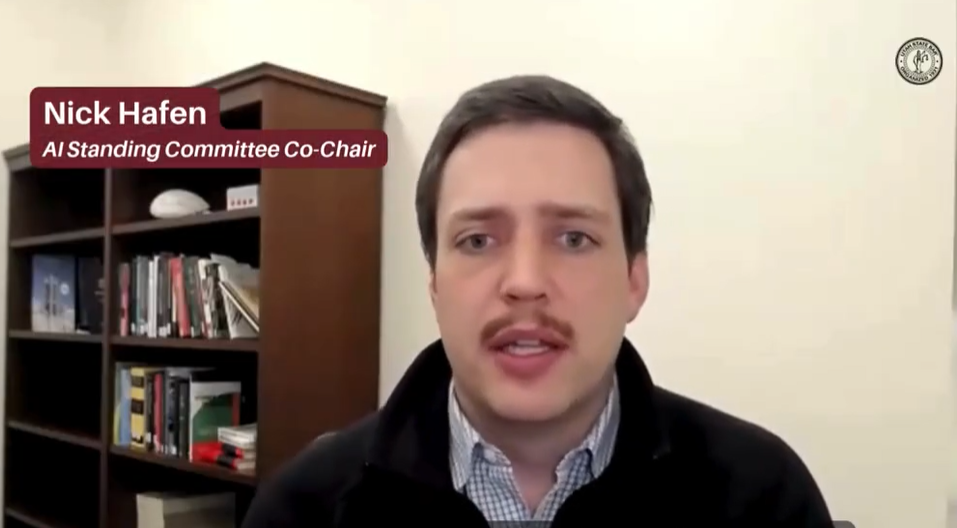
By Nick Hafen
AI Standing Committee Co-Chair

Guest Blog

We’re still seeing too many headlines about lawyers misusing generative AI. While the core ethical duties of competence, confidentiality, and honesty remain exactly the same, the arrival of AI tools introduces new wrinkles that the profession must understand. Generative AI isn’t going away, and it offers tremendous promise, but only if we use it thoughtfully.

Here are five key considerations for practicing law responsibly in the era of AI.

1. Always Verify the Content

Generative AI isn’t Google, Westlaw, or Lexis. Traditional research tools point you directly to sources; generative AI creates new content based on training data. That can be incredibly useful for brainstorming, drafting, and summarizing, but it can also be completely wrong.

Before relying on any AI-generated legal information, go to the original authority, read it yourself, and exercise your own judgment. Verification isn’t optional.

2. Protect Confidentiality

The duty to protect client information predates AI, but generative tools add an extra layer of complexity. Many AI platforms use user inputs to train future models. That means anything you type could reappear — in whole or in part — later.

Whenever possible, use tools that do not train on your data. If a platform does train on user inputs, treat it as a public forum and never enter confidential or identifiable client information. The risk may be small, but the ethical duty is absolute.

3. Bill Honestly When Using AI

AI can drastically reduce the time required to complete certain tasks. But if you’ve agreed to bill by the hour, you can’t use AI to complete a two-hour assignment in two minutes and still charge for two hours. Efficiency doesn’t change the ethical obligation to bill accurately.

Looking forward, AI may make flat-fee, subscription, or value-based billing even more appealing, and potentially fairer, for both lawyers and clients.

4. Create & Follow an AI Policy

Every legal workplace should have a clear AI policy that identifies which tools are approved and for what purposes. Policies should address accuracy verification, confidentiality, billing, client disclosure (if applicable), and training.

An AI policy isn’t just risk management; it helps teams innovate responsibly.

5. Embrace AI Within Ethical Boundaries

The goal isn’t to avoid generative AI altogether. Used responsibly, it can help lawyers work faster, serve more clients, reduce costs, and expand access to justice. The legal profession has always evolved alongside new technology, and AI is simply the next chapter.

Explore it, learn it, and understand where it can add value, but do so with your ethical duties and workplace rules front of mind.

Generative AI is a powerful tool, not a shortcut. When lawyers combine new technology with time-tested professional values, clients benefit and the justice system becomes stronger.

NOTE: Licensees have free access to an AI resource hub powered by LexisAI. Log in to your Practice Portal and add the Lexis card to explore white papers, webinars, and videos about best practices using AI in the legal profession.

Utah Judiciary Responds to Threats in Redistricting Case

PRESS RELEASE

Salt Lake City, Utah (November 17, 2025) — In response to multiple requests for comment regarding Judge Dianna Gibson’s ruling in the Utah Women Voters v. Utah State Legislature redistricting case, the Utah Judiciary issues the following statement:

Though the Utah Judiciary does not comment on the specifics of any threats made toward judges or court employees, we acknowledge that such incidents have recently occurred. We call on everyone to approach concerns involving the courts with civility, respect, and constructive dialogue.

Threats of violence against judges or court personnel are unacceptable, dangerous, and may violate state or federal law. Any conduct aimed at causing fear for a ruling or undermining the safe operation of the justice system strikes at the heart of the rule of law. Such actions endanger not only the individuals targeted but the functioning of the justice system itself.

Judges have a constitutional duty to apply the law to the facts before them, independent of external pressures. That independence is essential to preserving the separation of powers and ensuring that justice is administered fairly and impartially.

When parties disagree with a judicial ruling, the appropriate and lawful avenue for addressing those concerns is the established appellate process. Utah’s courts provide a structured and transparent system for reviewing decisions and correcting potential errors, reinforcing public confidence in the integrity of the judicial process.

We encourage all Utahns to stand with the Judiciary in protecting the safety of our judges and employees and protecting the fair and impartial administration of justice.

###

CONTACT: Tania Mashburn
She/Her/Hers
Director of Communications
801-712-4545
taniam@utcourts.gov

RELATED: Utah State Bar Statement on Call for Judge Gibson Impeachment

Honoring Excellence: Utah State Bar Fall Forum Award Recipients

Each year, the Utah State Bar Fall Forum celebrates individuals nominated by their peers whose careers reflect the highest standards of professionalism, service, and integrity. This year’s distinguished award recipients exemplify what it means to serve justice, mentor others, and advance the rule of law. We proudly pay tribute to Jonathan O. Hafen, Wendy M. Brown, Thomas R. BartonF. Joseph Paldino, and Brandon Owen.

__________________

Jonathan O. Hafen: Lawyer of the Year

Jonathan O. HafenJonathan O. Hafen, a partner at Parr Brown Gee & Loveless, has spent his distinguished career at the intersection of commercial litigation, public service, and community leadership. A skilled trial lawyer, Jon has handled complex disputes involving investor fraud and business ownership, most notably serving as court-appointed Receiver in the Rust Rare Coin Ponzi scheme—a massive fraud case in which he and his team have recovered over $50 million for victims to date.

A former clerk to Chief Judge Monroe G. McKay of the Tenth Circuit and a veteran of Sidley Austin’s Chicago office, Jon brings both intellectual rigor and practical wisdom to his practice. His dedication to the profession extends far beyond the courtroom: he recently completed his term as National President of the Federal Bar Association, chairs the Utah State Bar’s CLE Advisory Committee, and serves on multiple boards, including the Utah Center for Legal Inclusion and the Bar’s Leadership Academy.

Jon’s leadership extends to civic life as well. He chairs the Tuacahn Center for the Arts Board, co-chairs the Women’s Leadership Institute, and serves on the Salt Lake Chamber’s Executive Board. His founding role in Utah Lawyers for Good Policy reflects his belief in the power of the legal community to shape thoughtful, nonpartisan dialogue on issues affecting Utah.

Widely regarded as a mentor and role model, Jon was the inaugural recipient of the Charlotte Miller Mentoring Award and has been honored by organizations including the Salt Lake Chamber, BYU Law School, and the Federal Bar Association. His example reminds us all that true professionalism is measured not just by achievement, but by service.


Wendy Brown: The Charlotte Miller Outstanding Mentoring Award

Wendy M. BrownAt the Utah Indigent Appellate Defense Division, Wendy Brown leads with passion, precision, and purpose. As head of the Criminal Appeals Division and the Division’s law clerk program, Wendy has dedicated her career to ensuring that indigent defendants receive the highest quality appellate representation—a mission that embodies the very heart of equal justice.

A graduate of Creighton University School of Law, magna cum laude, Wendy’s path to public defense was shaped by a series of appellate clerkships with the Utah Court of Appeals, where she honed her legal analysis and deep respect for the rule of law. Her mentors—Judges Gregory K. Orme, Pamela T. Greenwood, and David N. Mortensen—helped instill the values she now imparts to her own mentees.

When IADD began handling in-house appeals, Wendy became the Division’s first appellate attorney, playing a pivotal role in building its programs and culture from the ground up. She also serves on the Utah Supreme Court’s Advisory Committee on the Rules of Evidence and the Executive Committee of the Bar’s Appellate Practice Section, where she formerly served as chair.

Her leadership and advocacy ensure that the promise of justice is not reserved for the few but made accessible to all—a legacy that strengthens Utah’s legal system at its very foundation.


Thomas R. Barton: The James Lee Outstanding Mentoring Award

Thomas R. BartonFew attorneys embody the breadth and depth of courtroom excellence like Thomas R. Barton, litigation practice co-chair at Parsons Behle & Latimer. Since beginning his career in 1994, Tom has developed one of the most versatile and respected litigation practices in the Intermountain Region.

His experience spans contract and corporate disputes, real property issues, professional liability, tax and estate controversies, natural resource litigation, employment matters, and statutory claims. Representing both plaintiffs and defendants, he has tried cases in state and federal courts, the U.S. Tax Court, and before numerous administrative bodies. His advocacy has also reached the Utah Supreme Court, the Utah Court of Appeals, and the Tenth Circuit Court of Appeals.

Beyond his advocacy, Tom has served the courts as a trusted receiver in complex cases involving securities and consumer fraud—roles that speak to his fairness, analytical rigor, and commitment to the integrity of the legal system. His ability to assess claims, establish facts, and navigate complex procedural landscapes makes him a true steward of justice.

Before joining Parsons Behle & Latimer in 2019, Tom held leadership positions at two prominent Salt Lake City firms, including serving as president of one. His long-standing dedication to excellence continues to elevate Utah’s litigation community.


F. Joseph Paldino: The Paul Moxley Outstanding Mentoring Award

F. Joseph PaldinoF. Joseph Paldino has built an extraordinary career defined by leadership, mentorship, and innovation in immigration law. As a Partner at Fragomen and head of the firm’s Salt Lake City office, Joseph manages a team that bridges clients across the New York and Utah offices, offering strategic immigration guidance to global organizations navigating an increasingly complex legal environment.

With nearly 30 years of experience, Joseph develops customized immigration programs for clients across industries, advising on everything from temporary visas and permanent residency to compliance, citizenship, and the immigration implications of mergers and acquisitions. His approach—rooted in trust, collaboration, and adaptability—has earned him widespread respect in both the business and legal communities.

A proud graduate of Fordham University and St. John’s University School of Law, where he earned his J.D. cum laude, Joseph’s professional life reflects a deep commitment to service. He is known not only for his expertise but also for his mentorship of the next generation of immigration professionals, empowering them to uphold the highest ethical and professional standards.

__________________

Brandon Owen: Special Service Award

Brandon OwenBrandon Owen is an intellectual property attorney and shareholder at Ray Quinney & Nebeker, focused on litigation and counseling across trademarks, copyrights, trade dress, and patents. He is also a registered patent attorney. He previously clerked at the U.S. Court of Appeals for the Federal Circuit for Judge Randall R. Rader. A former University of Utah men’s tennis player, Brandon channels the discipline, teamwork, and coaching mindset he learned on court into his service. He has coached his four sons, two who currently play for the BYU Men’s Tennis team, a third will join the team next fall, and a fourth will compete for Southern Virginia University, and he volunteers to broaden access to healthy recreation.

For years, Brandon and his sons have taught tennis and pickleball at the elementary school in Bluff, Utah, where roughly 98% of students are Navajo. After tribal leaders shared with Brandon and his family their concerns about a diabetes epidemic on the Navajo Nation, Brandon has visited Bluff elementary over the years, painting tennis and pickleball lines at the school and community center, donating racquets and supplies, organizing after-school clinics and activities, fundraising for supplies, and visiting the Navajo Senior Center to support active living for elders. Many of the Navajo youth travel via bus an hour each day to get to Bluff Elementary and many of the youth eat all three meals at the school.

Closer to home, Brandon has taught court skills and life skills to justice-involved youth through Judge Valdez’s “It Takes a Village”/Tennis ad Tutoring program at Liberty Park and has devoted countless hours assisting Brighton High School tennis and coaching youth teams. He believes the talents we cultivate in our professions and passions carry an obligation to teach, contribute, and lift others, and he strives to do exactly that, one lesson, one clinic, and one community at a time. 

__________________

Celebrating Excellence and Service

We congratulate each of these remarkable attorneys on their well-deserved recognition and thank them for their enduring contributions to Utah’s legal community.

*AI assisted with the writing of this blog.

Utah State Bar Statement on Call to Impeach Judge Gibson

The Utah State Bar strongly condemns any effort to impeach Judge Dianna Gibson based on her recent ruling.

Judges are charged with applying the law to the facts of their cases without regard to politics or public opinion. Using impeachment as retaliation for an unfavorable decision undermines the rule of law and the separation of powers that safeguard our system of government.

The judiciary must remain free from political pressure so all Utahns can have confidence in fair, impartial courts. Impeachment is reserved for serious misconduct, and disagreement should instead be addressed through the appeals process.

We urge all public officials and Utahns to respect the role of the judiciary and the independence of Utah’s courts.

How to Minimize the Risk of Becoming a Victim of Wire Fraud

Guest Blog
By Mark Bassingthwaighte, Esq.

Lawyers remain a high-profile target for scammers hoping to get away with wire fraud and the attack vectors they are using continue to evolve. Here’s just one example of how these scams typically work today. A lawyer represents a seller in a real estate transaction. Unbeknownst to anyone involved, someone has hacked into and been monitoring the seller’s email for a period of time. Once aware that a transaction is about to take place, the hacker uses a spoofed email address of the seller to send new wiring instructions to the lawyer in order to have the funds sent to an account the hacker has access to. The lawyer fails to catch the altered email address and ends up wiring the proceeds to the wrong bank. So not good.

As an aside, some may wonder what a spoofed email might look like. Although there are a number of ways to spoof email, it can be as simple as this. If an actual email address is Lawfirm@gmail.com, a spoofed address might be Lawfirm@gmaiI.com. If an actual email happens to be Mark.Bassingthwaighte@RECompany.net a spoofed address might read Mark.Bassingthwaite@RECompany.net. Given the busy days we all have, would you catch a subtle change made in an email address like the two examples above? Many would not. It’s particularly hard to see that the small letter l was changed to a capital letter I in the Gmail example. Also, be aware that in situations like the above example, the person whose email account has been breached varies, sometimes it’s a lawyer’s account, sometimes it’s the seller’s, and often it’s the realtor’s.

Regardless, all lawyers need to understand that hackers don’t act immediately. Often, they will monitor breached email accounts for at least several weeks, and sometimes for months, in order to understand the business practices that are in play and to wait for an opportunity to redirect a significant wire. And just as important, lawyers need to know that these scams are not directed solely at those who practice in the real estate space. Scammers know that lawyers in a variety of practice areas move money and thus view all lawyers as potentially lucrative targets.

The more common wire fraud attack vectors scammers are currently using include bogus invoices, altered documents to include e-faxes, email spoofing, false impersonation, and the oldie but goodie counterfeit check scam that continues to trip up far too many, which begs the question of what can be done to avoid becoming the next victim. Short of never being responsible for transferring funds of any kind, there isn’t anything you can do that will make you safe 100% of the time. However, the good news is you can get close.

First, security basics will always play a significant role. Of particular importance are the following. Never open any attachments or click on any links in email if the email comes from someone you don’t know or is unexpected. Make a habit of checking to make sure inbound email addresses are legitimate. Periodically review sent and deleted email for suspicious activity. With cloud-based email accounts, periodically check account rules to make sure no unauthorized rules have been created, for example, an automatic forward rule to an unknown account. Use unique strong passwords (a combination of letters, numbers, and symbols) on all email accounts. Beware of SMS text messages notifying you that your password has been reset without your knowledge. Enable two-factor authentication if available on all email and all financial accounts. Keep your firewall, operating system, and security software current and avoid using unsecured Wi-Fi. Limit what you post on firm websites and other social media accounts such as information about staff roles and responsibilities and out-of-office information because hackers can use this kind of information to determine who to target and when.

Second, establish a policy on wire transfers and couple that with appropriate training of anyone at your firm who may at some point be involved in a wire transfer, to include all attorneys. Initially, the policy should mandate the gathering and verification of contact information from all parties involved at the outset of representation and prohibit the use of any other non-verified contact information during the course of representation.

With that in hand, the most important provision of any such policy would be the implementation of a process that mandates that all wiring instructions must be confirmed using the previously verified contact information by way of an out-of-band communication channel. For example, if wiring instructions initially come via email or eFax, use a previously verified cell number to place a call to the relevant party to confirm the accuracy of the information received.

An additional relevant provision might be that all last-minute changes requesting that funds be transferred by a different method or to a different account be treated as highly suspect. The request should never be honored until verified as legitimate after contacting the person purportedly making the request through the use of previously verified contact information. If email security is a concern, another provision might be to require the use of encrypted email or a secure client portal to pass along wiring instructions. The absolute best option might be a provision that requires wiring instructions be delivered in person, for example, by the seller at a closing.

Finally, everyone in the firm should be trained to be suspicious and learn how to spot these kinds of scams. Underscore the necessity of remaining vigilant at all times. Training examples that address how these attacks look today might include the following. Look for inconsistencies with email such as various email addresses in use, different spellings of a name, and be suspicious of any email that comes from a free service such as Gmail or Yahoo. Always carefully check the address of relevant email coming in to make sure it exactly matches the previously verified address in your file. Always question requests for money to be sent to an account that is not in the name of the seller or not in the jurisdiction where the seller is. Be suspicious of requests to wire money when key personnel, such as the attorney in a solo practice, are out of the office or requests that are urgent in nature. And last but not least, remind everyone that just because the grammar and spelling look great, that doesn’t mean the email is legit. Scammers can be quite adept in drafting professionally written email.

Mark Bassingthwaighte, Esq. Is the resident Risk Manager at ALPS Insurance. To learn more about how ALPS can support your solo or small firm visit: alpsinsurance.com

RELATED: How to Overcome the Winter Blues and Find Wellness

Search UtahBar.org